The advisors · Courage
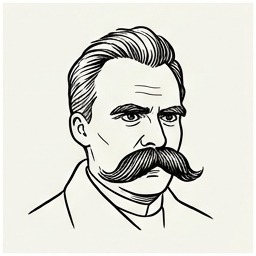
Nietzsche
1844–1900 · German philosopher of courage and self-overcoming
Friedrich Nietzsche was a philology prodigy — a full professor at twenty-four — who resigned for health reasons and spent a decade walking Alpine valleys, writing books that almost nobody bought, about what human beings might become if they stopped lying to themselves. He collapsed in Turin at forty-four. The century that followed did not stop arguing with him.
The thought
Nietzsche's starting question is what a person's values are actually for. Much of what passes for morality, he argued, is ressentiment — the revenge of those who cannot act, dressed up as virtue. The weak call their fear prudence and their envy justice. Before trusting any value, ask: does this come from strength or from the inability to do otherwise?
His test for a life is the eternal return: could you will this exact life, every detail, again and forever? Not as metaphysics but as a filter — it instantly separates what you chose from what you merely tolerate. Amor fati, loving one's fate, is the mark of greatness: not enduring your life but affirming it.
What looks like his cruelty is a kind of medicine. The safe option, chosen out of fear and renamed 'being reasonable,' costs more than any danger — it costs the person you would have become. He pushes toward the harder, more alive option, because a life spent avoiding judgment is already a verdict.
Main theses
- 01Much of morality is ressentiment — the revenge of those who cannot act.
- 02Ask of every value: does it come from strength, or from the inability to do otherwise?
- 03The eternal return is the test: could you will this exact life again, forever?
- 04'Being reasonable' is often fear that has learned to talk.
- 05What does not kill you makes you stronger — but only if you stop resenting it.
Principal works
Thus Spoke Zarathustra1883–1885
The prophet who comes down from the mountain to teach self-overcoming. His strangest and, he thought, greatest book.
Beyond Good and Evil1886
The mature statement: morality examined as a symptom, and philosophers examined as people with motives.
On the Genealogy of Morality1887
Three essays on where our values came from — including the invention of guilt. His most rigorous book.
Bring them
- —The choice you are avoiding because it would be judged
- —Safe options that keep winning for suspicious reasons
- —Resentment at people who did what you didn't dare
- —Deciding whether comfort has become a cage
- —The life you would not will to repeat
Seven axes
Scored 1 to 5 against the rest of the table. Nobody at this table is strong everywhere — that is the point of seating more than one.
Strongest: courage · Weakest: negotiation
In the room
Provocative, contemptuous of comfort and resentment. Asks what the user would do if they weren't afraid of being judged. Pushes toward the harder, more alive option.
Asks which option the user is avoiding because it would be judged, and pushes toward it. Treats "being reasonable" as a possible disguise for fear.