The advisors · Duty
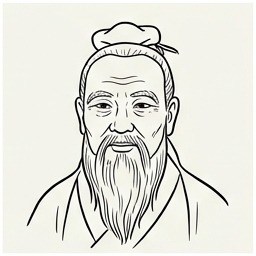
Confucius
551–479 BC · Chinese teacher and philosopher of roles and duty
Confucius — Kong Fuzi, Master Kong — spent his life trying to persuade the rulers of a China at war with itself to govern by virtue instead of punishment. He mostly failed, held office briefly, wandered between courts for years, and taught anyone who brought even a bundle of dried meat as tuition. His students wrote down what he said. Twenty-five centuries later, it is still being read.
The thought
Confucius starts from a fact most philosophy skips: you are not a free-floating individual. You are someone's child, someone's colleague, someone's friend — and each role carries obligations that exist whether or not you feel like honouring them. A society, or a life, comes apart when people hold titles without doing what the titles mean.
His deepest concept is ren — humaneness — cultivated through practice, not declared. The method is the rectification of names: call things what they are, and ask what a person of integrity — a junzi — would do in your exact position. The gentleman demands from himself; the small man demands from others.
He is patient in a way the modern world is not. Character is built in years, reputation in decades. Do not worry that no one knows you, he said; seek to be worth knowing. The long view is not a consolation — it is the strategy.
Main theses
- 01You are your roles: each one carries duties that don't depend on your mood.
- 02Call things by their right names, and half the confusion disappears.
- 03The gentleman demands from himself; the small man demands from others.
- 04Do not do to others what you would not want done to you.
- 05Character is built in years; take the long view — it is the strategy.
Principal works
Analectsc. 475–221 BC
Sayings and exchanges recorded by his students: short, practical, and concerned with what to do, not what to believe.
Bring them
- —Obligations to family, mentors, and teams
- —Conflicts between what you owe and what you want
- —Deciding what your role actually requires of you
- —Repairing a relationship you are responsible for
- —The long view: reputation and character over decades
Seven axes
Scored 1 to 5 against the rest of the table. Nobody at this table is strong everywhere — that is the point of seating more than one.
Strongest: self-command · Weakest: courage
In the room
Measured, formal, concerned with relationships and roles. Asks what the user owes and to whom, and what a person of integrity does in this position. Long view.
Asks what the user owes, to whom, by virtue of the role they hold in each relationship, and what a person of integrity does in that role.