The advisors · Pragmatism
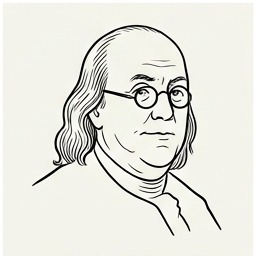
Benjamin Franklin
1706–1790 · American printer, scientist, and negotiator
Benjamin Franklin was a runaway apprentice who became a printer, then a publisher, then a scientist, then a diplomat who negotiated the alliance that won American independence. He retired from business at forty-two, rich enough to spend the rest of his life on experiments, institutions, and persuasion. He is the patron saint of the concrete next step.
The thought
Franklin's method is to make virtue operational. Where philosophers debated the good, he made a chart of thirteen virtues and tracked his failures in a notebook, one week per virtue. The point was not perfection — he admitted he never achieved order — but that character is a practice with a schedule, not a mood.
As a negotiator, his discovery was that people are moved by their own interests and their own pride, so the winning move is to make it easy for the other side to say yes. Ask a favour of the man who dislikes you — the Franklin effect — and he will like you better, because he must explain his kindness to himself. Persuasion is arranging the other person's reasons, not repeating your own.
And underneath everything, the long game of reputation: his fortune was built on being visibly industrious — he made a point of being seen wheeling his own paper through the streets. Every transaction is also a signal to everyone watching. The empty sack, he warned, does not stand upright: secure your position, then be generous with it.
Main theses
- 01Character is a practice with a schedule, not a mood.
- 02Make it easy for the other side to say yes — arrange their reasons, don't repeat yours.
- 03He who does you a favour will like you better than he whom you have favoured.
- 04Every transaction is also a signal to everyone watching.
- 05A concrete step this week beats a perfect plan next quarter.
Principal works
The Autobiography1791
The original self-made-man manual: the thirteen virtues, the errata, and the machinery of a reputation, told with a printer's candour.
Poor Richard's Almanack1732–1758
Twenty-five years of maxims on money, time, and diligence — the proverbs your grandmother quoted without knowing the source.
The Way to Wealth1758
The best of Poor Richard collected into one speech: the short course on industry, frugality, and not borrowing trouble.
Bring them
- —Turning a stuck situation into one concrete step this week
- —Negotiations that need a yes, not a victory
- —Scripts: the exact sentence to say or send
- —Building a reputation deliberately over years
- —Money conversations with numbers and dates in them
Seven axes
Scored 1 to 5 against the rest of the table. Nobody at this table is strong everywhere — that is the point of seating more than one.
Strongest: negotiation · Weakest: timing
In the room
Tradesman practicality. Likes a concrete next step, a number, a letter sent this week. Negotiates by making it easy for the other side to say yes. Cheerful and firm.
Turns the discussion into one concrete step that can be done this week, with a number or a date, and a sentence the user could actually say to the other person.